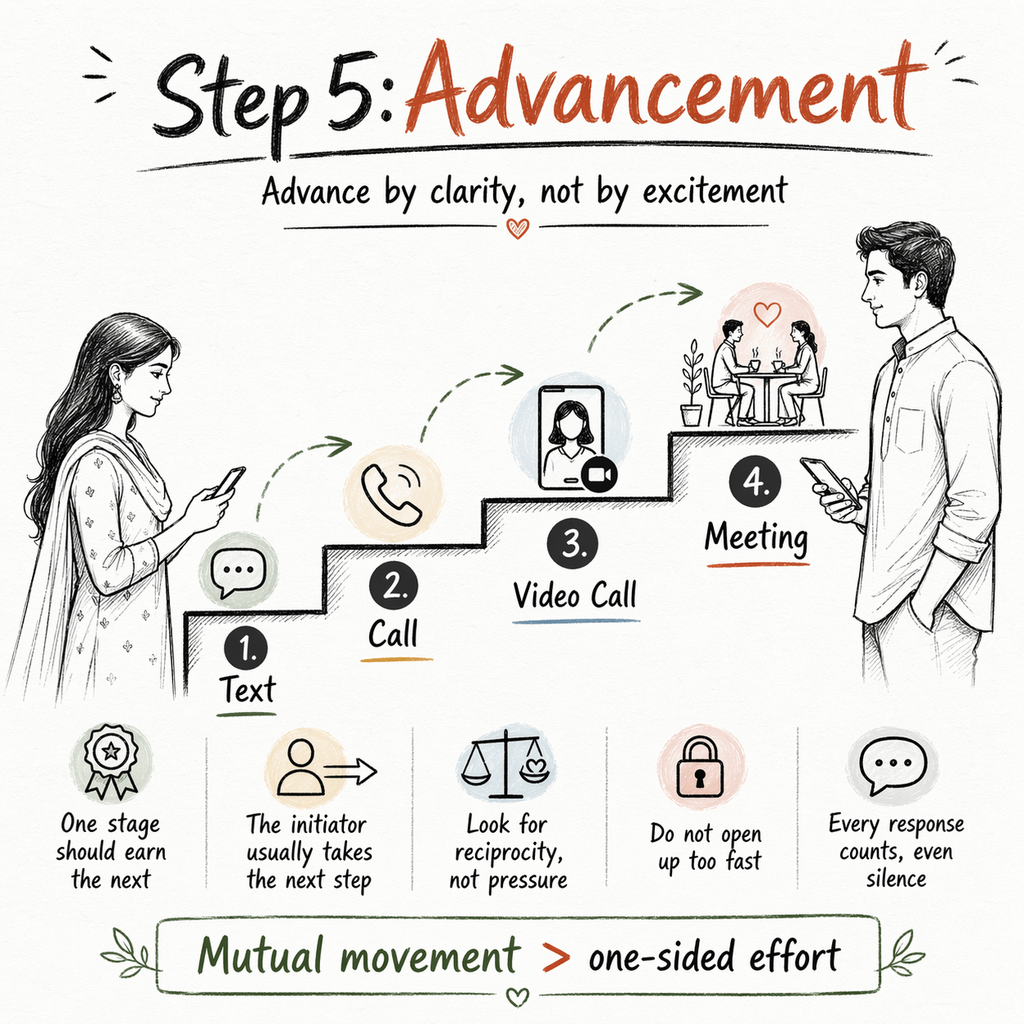
Step 5: Advancement
A lot of people know how to start arranged marriage conversations.
Very few know how to advance them properly.
That is where confusion begins.
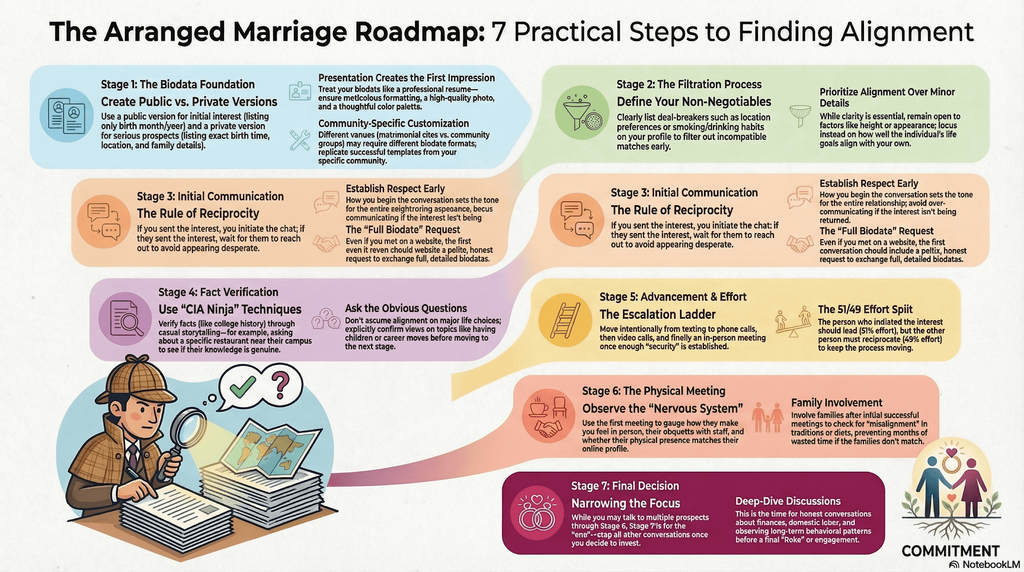
This is Step 5 out of the 7 stages: Advancement.
This is the stage where things move from:
- text
- to call
- to video call
- to meeting
And if you do this stage badly, you can ruin a setup that was actually going fine.
Following are the points:
1. Advancement means one stage earns the next
If you were texting, then the next step is a call.
If you were on calls, then the next step is a video call.
If the video call is going well and basic clarity is there, then you can move to meeting.
Do not jump randomly.
2. The person who initiated usually advances it
If you were the one who showed interest first, or began the conversation first, then usually it is also you who should initiate the next step.
That means:
- you suggest the call
- you suggest the video call
- you suggest the meeting
This does not mean doing everything alone. It just means carrying 1% more initiative in the beginning.
3. Do not expect 50-50 in exact form
Early on, exact 50-50 rarely works like people imagine.
A better way to see it is 51-49.
The person who initiated takes that extra 1% by moving things ahead.
But the other person should still be showing interest, clarity, and willingness.
If it becomes 90-10, that is not reciprocity. That is imbalance.
4. If you expect the other person to carry what you started, pressure begins
This is where many people go wrong.
They show interest first, start the process, and then expect the other person to do the advancing.
That often creates pressure.
And pressure creates discomfort.
Discomfort slows things down.
Then people call that delay “confusion.”
5. Advancement is where receptivity gets tested
This stage is not only about moving ahead.
It is also about seeing how the other person shows up.
Observe:
- do they remember things about you?
- are they present in communication?
- are they transparent?
- do they provide clarity, or more confusion?
- are they available for talking?
- are they genuinely involved, or just floating through?
This is the phase where receptivity becomes visible.
6. Every response is not verbal
At this stage, every response matters.
Not only words.
Also timing.
Also silence.
Also effort.
Also whether they show up properly.
So yes, silence is also communication.
A delayed call, a vague answer, a forgotten detail, a repeated excuse, all of these tell you something.
7. Do not open up too much just because things are going well
This is very important.
Sometimes at this stage, things may actually go very well.
You may feel the urge to open up quickly.
You may feel like, okay, now I can relax and emotionally lean in.
Not yet.
Because even here, complete clarity is still not there.
If you open up too much too early, you blur the line very fast.
And if later something goes wrong, pulling back becomes much harder.
So even if things are going well, stay emotionally resilient.
8. This stage is still about clarity, not deep emotional bonding
A lot of people make this stage too emotional too early.
But honestly, most conversations here should still remain around:
- non-negotiables
- verification
- practical alignment
- communication style
- availability
- seriousness
Not fantasy.
Not over-sharing.
Not acting like the bond is already established.
9. Each stage shows a different part of the person
Texting shows:
- their communication style
- their consistency
- their availability
- the level of importance they are giving
Voice calls show:
- how they think
- how they express
- how they hold conversation without visual support
Video calls show:
- presence
- comfort level
- expression
- whether the interaction still feels aligned face-to-face
Every stage gives different information.
That is why each stage matters.
10. If you are meeting, the initiator usually takes the longer step
If you are the one pushing the advancement, then yes, you may have to take the longer ride or the longer journey.
But that does not mean doing everything for them.
It means you take the lead in movement, and they should still show effort in participation.
For example, if you travel to their city, they should still come properly to meet.
They should not make everything unnecessarily difficult unless there is a genuine reason.
That is also part of receptivity.
11. Practical effort matters more than sweet words here
At this stage, do not only look at what they say.
Look at:
- do they make time?
- do they make things easier or harder?
- do they show interest through action?
- do they match the movement with effort?
Because advancement is less about promises and more about participation.
12. This is still the stage where you can keep options open
You do not have to emotionally lock into one person here.
This is still a stage where you may be speaking to multiple prospects.
And that is okay.
The one who gives basic clarity, receives basic clarity, and naturally advances stage by stage without unnecessary confusion, that person stands out.
That person moves from:
- text
- to call
- to video call
- to meeting
more effortlessly.
13. The whole point is reciprocity
That is the real idea of this stage.
Not speed.
Not pressure.
Not emotional intensity.
Reciprocity.
If interest is real, advancement feels smoother.
If advancement always feels forced, one-sided, or confusing, then that itself is information.
14. The next stage comes only after this is earned
Once text, call, and video call have given enough basic clarity, then you can:
- involve parents if required
- or move to the next step, which is the first meeting
But do not move ahead only because time has passed.
Move ahead because clarity has increased.
Advancement should feel like mutual movement, not one person dragging the process forward.