I think most people do arranged marriage in the wrong order.
They get emotionally involved first, clarity later. Then they wonder why they are confused after 2 months.
My view is simple: arranged marriage should be done in stages. Not because love should be robotic, but because confusion becomes very expensive very fast.
This is the order I think works.
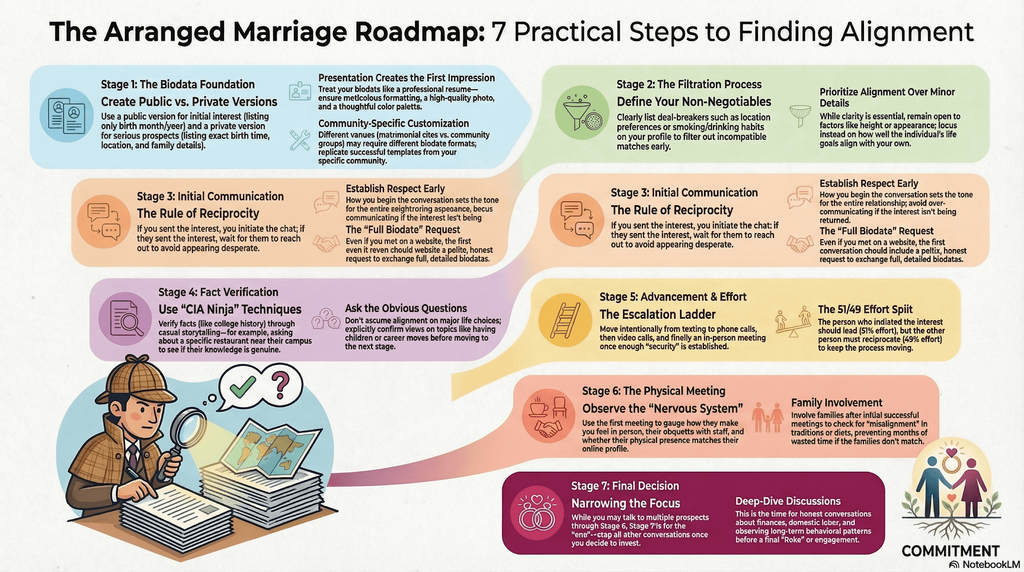
First, biodata.
Make two versions, not one. One public, one private.
Public one should be clean, neat, and give enough information without giving away everything. Private one can have the extra details you only want to share one-to-one. A lot of people overshare too early and then regret it.
Also, people underestimate how much bad formatting, vague writing, and sloppy details affect first impression. Your biodata is not your whole personality, but it is your first filter.
Second, filters.
Most people say they want clarity, but they have never actually written down their non-negotiables.
I’m not talking about fantasy shopping list stuff. I’m talking about the real things: city, family structure, smoking, drinking, kids, finances, lifestyle, religion, diet, work expectations.
And yes, be clear, but do not become so rigid that you reject people for nonsense.
A lot of delay in arranged marriage is not rejection. Sometimes the other person is already speaking to someone. Sometimes timing is off. Sometimes life is happening. So don’t act defeated just because one person did not respond well.
Third, initiate communication properly.
This matters more than people think.
If you sent the interest and they accepted, then you can begin. If they showed interest first, let them take that first step. I know some people will disagree, but I have seen this again and again: the person who over-initiates too early usually creates imbalance very fast.
And once imbalance starts, confusion starts.
The first goal of communication is not romance. It is clarity.
Ask for the full biodata if needed. Compare profile and biodata. See if basic facts align. Don’t start doing 2-hour phone calls with someone whose basics are still unclear.
Fourth, verification.
This is the stage most people skip. Then they call the outcome “bad luck”.
Ask the obvious questions.
Actually ask them.
I learned this the hard way. Once I spoke to someone for nearly 2 months and only later found out she did not want kids. That was a complete dealbreaker for me. People told me later, “But that is obvious, why would you ask that?” Exactly. I thought it was obvious too. It wasn’t.
That one experience taught me something very simple: in arranged marriage, never assume the obvious is obvious.
If something matters to you, ask early.
Kids. Smoking. Drinking. Family involvement. Relocation. Career after marriage. Money mindset. All of it.
Not like an interrogation. Like a conversation.
Also, if you expect transparency, give the same transparency.
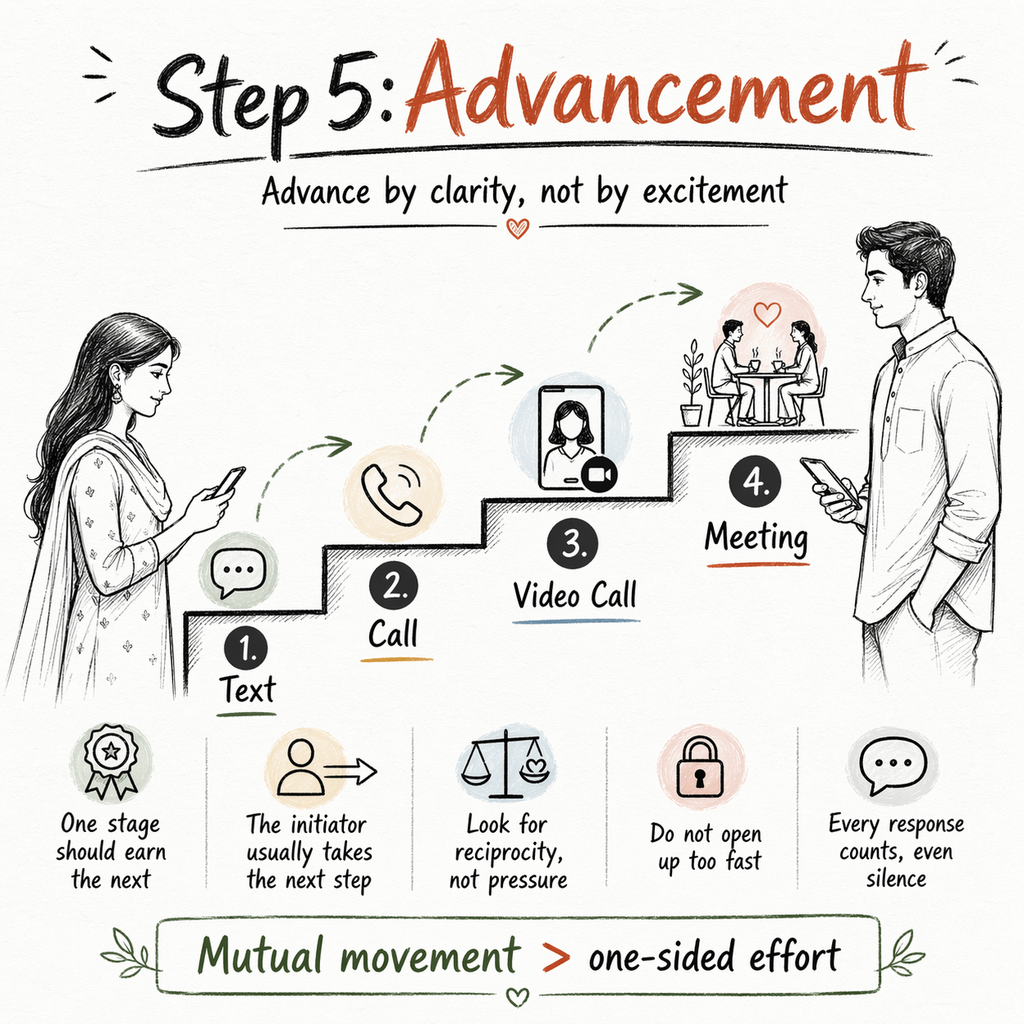
Fifth, advancement.
Texting to call.
Call to video call.
Video call to meeting.
Not texting for 3 weeks and then behaving like you are already half-married.
Every stage should earn the next one.
And yes, in the early part, the person who initiated usually has to take slightly more initiative in moving it forward. That doesn’t mean doing all the work. It just means not expecting the other person to carry what you started.
I usually think of it like this: 51-49 is fine. 90-10 is nonsense.
Sixth, the first meeting.
This is where reality starts.
Video calls can still hide a lot. In-person presence does not.
How do they carry themselves? How do they speak to staff? How do you feel in their company? Calm? Drained? Guarded? Rushed?
Your nervous system catches things before your brain writes an essay about it.
I had one situation where things looked quite good one-to-one. Conversations were good, meetings were good, interest was there. But when family got involved, it broke very quickly. The mismatch was not even some dramatic issue. It was diet. That’s all. The person knew it, but the family didn’t fully know it, and once that came out, the whole thing collapsed.
That taught me another lesson: sometimes the match is fine, but the ecosystem is not.
People ignore that.
Seventh, decide clearly.
Only after all this do you seriously ask: is this actually my person, or am I just attached because I have already invested time?
That is a brutal but necessary question.
By this stage, you should be discussing deeper things properly: finances, routines, emotional style, family boundaries, future plans, conflict style, all of it.
And this is also where I think many people go wrong. They reach this stage with confusion, and then try to solve that confusion by forcing more emotion into it.
But if stage 7 feels confusing, usually the problem started in stage 2, 3, or 4.
You ignored a mismatch.
You rushed a stage.
You over-initiated.
You assumed instead of asking.
You kept going because “let’s see”.
That “let’s see” mindset costs people months.
My honest opinion?
Stage 1 to 6 should not take forever. Sometimes it happens in days. Sometimes weeks. Fine. But if basic clarity is taking ages, something is already off.
Arranged marriage becomes much cleaner when you stop romanticising confusion.
Don’t rush.
Don’t assume.
Don’t overshare too early.
Don’t get emotionally invested before facts and effort both match.
Clarity is not being cold. And if you are still confused you can connect with me.
Clarity is respect.